热门资讯> 正文
SA Roundtable: Will AI eliminate more jobs than it creates?
2025-09-06 03:29
- 海桥黄金(SA) 0
- C3.ai(AI) 0
- 蒙特利尔银行(BMO) 0
Will AI be a job crusher or creator?
In a recent Seeking Alpha readers poll, 69% of the over 1,500 respondents said they thought the revolutionary technology would end up eliminating more jobs than it creates, with 31% disagreeing.
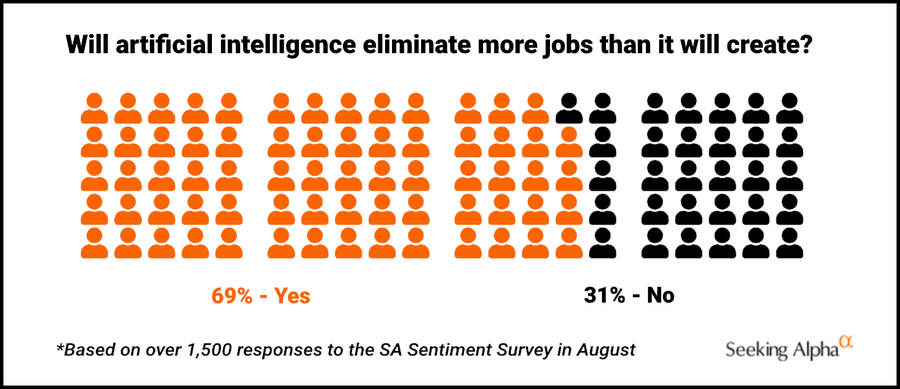
Seeking Alpha readers poll on AI and jobs (Seeking Alpha)
We asked Seeking Alpha analysts Justin Purohit, Jeremy LaKosh and Chris Lau their thoughts on how AI will impact the labor market, which jobs could be most at risk of elimination, and which jobs could be relatively safe.
Do you think AI will eliminate more jobs than it creates?
Justin Purohit: I don’t necessarily believe AI will lead to a net increase in wholesale job loss, per se. Rather, I see AI reshaping the landscape, mostly for the better. AI would likely continue to automate routine tasks while creating new demand for workers who can guide, interpret, and innovate with the tools. Roles that are more routine or that involve middle-skill work would be most at risk from this trend, while those involving higher-level oversight or strategic judgment would benefit. The bigger challenge, in my view, is ensuring that career pathways adapt so employees can build skills in this new landscape.
Jeremy LaKosh: No. There have been many breakthroughs in productivity since the Industrial Revolution and each of them has brought fears of labor reduction. Companies whose industries are disproportionately affected by AI will either adapt or die, much like Studebaker shifted from horse and buggy to cars. AI will transform our economy much in the same way that the personal computer transformed us thirty years ago, and nobody is longing for the resurgence of the typewriter.
Chris Lau: Artificial intelligence is already eliminating jobs whose tasks are repetitive. This trend will increase as AI gets better. Chatbots are already replacing front-line call center positions.
The Bank of Montreal (BMO) announced hundreds of cuts in call-center positions. IBM (IBM) reportedly slashed 8,000 jobs in May, replacing HR roles through its AI-driven restructuring.
That said, billions of AI investments from Meta (META) and Alphabet (NASDAQ:GOOG) will require IT staff to maintain AI servers and optical networks.
What types of jobs are most at risk of being eliminated in the next five to ten years?
Justin Purohit: I believe the jobs most at risk of elimination are those that are routine, repetitive, or rules-based. Some examples would include customer service, data entry/bookkeeping, and certain pockets in the HR and legal departments. Robots and AI are already displacing low-skill and middle-skill jobs, such as in warehousing. The continuation of this may not only further reshape the labor market, but it could also fuel broader social and political shifts as affected workers lose stability.
Jeremy LaKosh: In any advancement, entry-level work seems to be most impacted by technological change. I believe that financial analyst positions could be in trouble if AI can replicate research reports. I also believe that level 1 customer service positions will be transformed into an automated chatbot, but I’m not sure how many people will long for customer service positions. With the dynamics of our current labor market, it appears as if younger people will be disproportionately affected by the implementation of AI.
Chris Lau: Jobs in traditional media outlets and advertorial firms are at risk. AI may compile and write news headlines that sustain readership. AI already knows how to write clickbait headlines.
Media firms like Omnicom (OMC) are facing tremendous pressure from AI. Even though AI is limited to very short videos, large language models will improve. Eventually, it may make full-length videos.
Programmers are at a high risk of job losses in one to five years. Many AI systems write code effectively. They are already writing basic games. Still, EA (EA) and Take-Two (TTWO) cannot fully replace their game developers. AI may write the basics, but it needs people to customize the code.
Middle management jobs have a high risk of job cuts. Google (NASDAQ:GOOG) (NASDAQ:GOOGL) cut managerial staff by 35%.
Which jobs are least at risk of being eliminated in the next five to ten years?
Justin Purohit: I continue to believe that jobs that require uniquely human skills, such as empathy and leadership, are the most resilient. Roles in healthcare, education, skilled trades, and relationship-driven fields will likely continue to be insulated, especially where human judgment and trust can’t be automated. I believe that these areas will see AI as a tool for support rather than a replacement.
Jeremy LaKosh: Doctors and lawyers will still be around after the AI market has matured. There’s still a need for human interpretation of complex and important matters. I’ve been impressed with AI in what it has been able to produce, but in matters that can significantly impact a person’s life, I don’t think humanity will be turning its trust over to computers anytime soon. Those individuals with specialized skill sets that can adapt to changes in the labor market will excel in the new AI-driven economy.
Chris Lau: Jobs that require manual dexterity are least likely to be eliminated. Society needs plumbers, dental hygienists, and electricians. The impact on manufacturing jobs is unknown. This has more to do with the U.S.’s attempt to bring them back. Unfortunately, the U.S. does not have the labor cost advantage that its trade partners have, even with punitive tariffs in place.
- Trending AI Stocks
- Leading AI/AI-related stocks: Alphabet (NASDAQ:GOOG) (NASDAQ:GOOGL), Amazon (NASDAQ:AMZN), Microsoft (NASDAQ:MSFT), Meta (META), Nvidia (NVDA), Advanced Micro Devices (AMD), Palantir (PLTR).
More on Microsoft, Amazon, etc.
- Alphabet Has Just Received Game-Changing News
- Alphabet Fair Value Analysis: The Stock Is Still Cheap
- Case Closed: What's Next For Alphabet? (Rating Downgrade)
- Tech Voices: Nvidia-Quantinuum, Fed AI job survey, OpenAI upskilling
- Microsoft unveils free AI access for certain students, teachers as part of presidential push
推荐文章
港股周报 | 中国大模型“春节档”打响!智谱周涨超138%;巨亏超230亿!美团周内重挫超10%

一周财经日历 | 港美股迎“春节+总统日”双假期!万亿零售巨头沃尔玛将发财报
一周IPO | 赚钱效应持续火热!年内24只上市新股“0”破发;“图模融合第一股”海致科技首日飙涨逾242%
从软件到房地产,美国多板块陷入AI恐慌抛售潮
Meta计划为智能眼镜添加人脸识别技术
危机四伏,市场却似乎毫不在意
美股机会日报 | 降息预期升温!美国1月CPI年率创去年5月来新低;净利、指引双超预期!应用材料盘前涨超10%
财报前瞻 | 英伟达Q4财报放榜在即!高盛、瑞银预计将大超预期,两大关键催化将带来意外惊喜?